
Tilt / Turn
Window
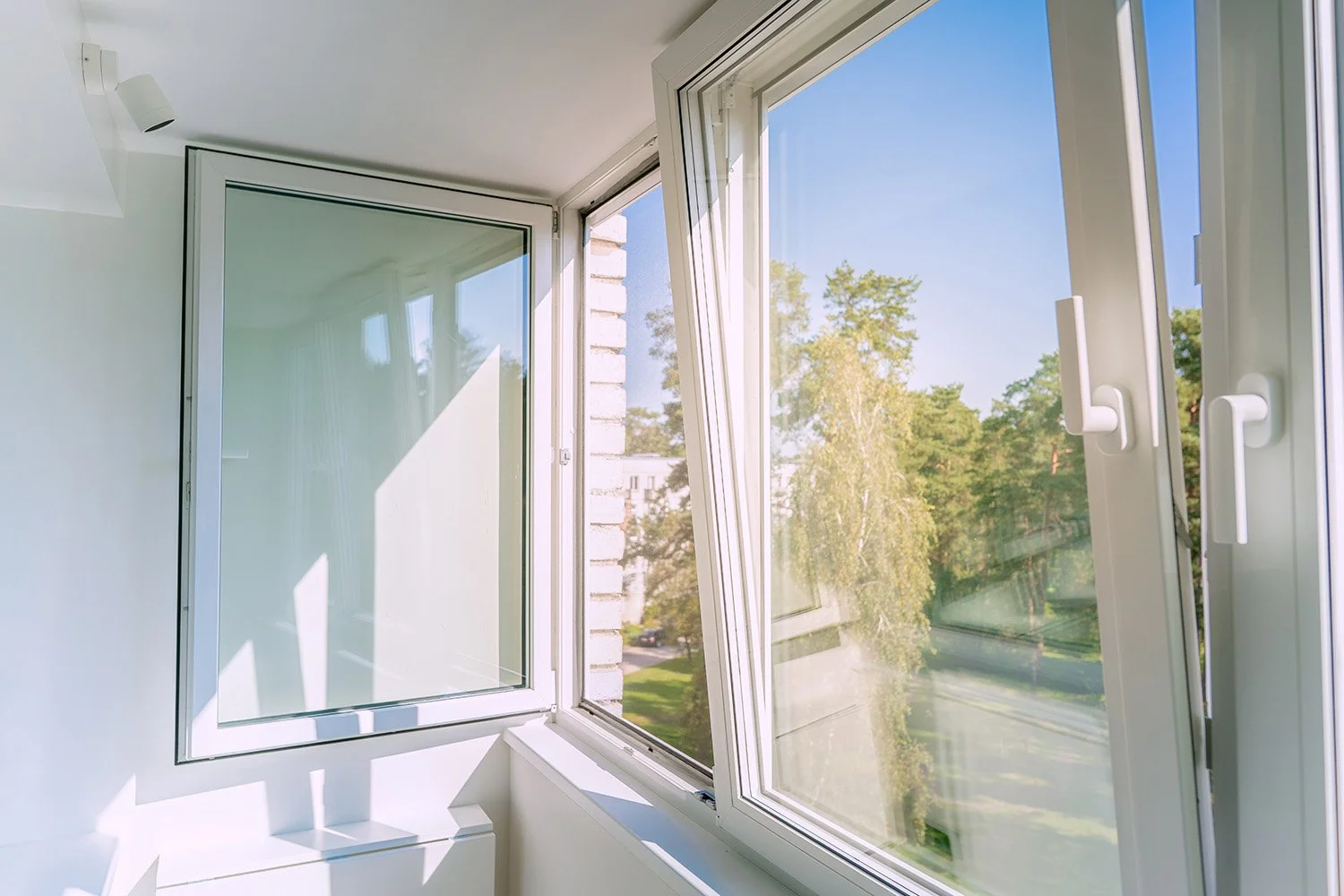
A tilt-turn window is functional genius.
It is a European-style window that combines a hopper window and a casement window into one. Simply tilt the window in from the top for modest ventilation, or use the handle to swing it in like a door for a full window frame opening. The multi-point locking system allows for the window to be stay securely closed when needed, and the gliding ease of operation allows for the window to open either as a tilt or turn.
DESIGN OPTIONS
Materials
-
Strength and Security:
Exceptional strength, can accommodate large panel sizes combined with very narrow sightlines, and its material hardness performs very well against forced entry.
Durability and Longevity:
Resistant to warping, cracking, rotting, and pests. Stands tall in the harshest of climates, and can last for generations.
Aesthetic Appeal:
Slim frame profiles allow for grand, expansive, and unobstructed use of glass, allowing for lots of natural light and design appeal. Well suited for modern, industrial, and historical projects.
Low Maintenance:
Minimal upkeep required.
Energy Efficiency:
Excellent energy efficiency, especially when combined with thermal breaks, insulated glass units, and low-e coatings.
Design Versatility:
Can accommodate a variety finishes and colors to match different architectural styles.
Eco-Friendly:
Highly recyclable, reducing environmental impact.
Noise Reduction:
Highly effective at dampening outside noise for quieter interiors.
-
Strength and Security:
Has a strength to weight ration that can’t be touched, can accommodate large panel sizes combined with narrow sightlines, and aside from steel, performs well against forced entry.
Durability and Longevity:
Resistant to warping, cracking, rotting, and pests, can hold its own in harsh weather, and has an impressive lifespan.
Aesthetic Appeal:
With a contemporary look and slim frame profiles, it allows for expansive use of glass, allowing for lots of natural light and design appeal.
Low Maintenance:
Almost zero upkeep.
Energy Efficiency:
Impressive energy efficiency, especially when combined with thermal breaks, insulated glass units, and low-e coatings.
Design Versatility:
Can accommodate a variety finishes and colors to match different architectural styles
Eco-Friendly:
Highly recyclable, reducing environmental impact.
Noise Reduction:
Effective at dampening outside noise for quieter interiors
-
Durability and Longevity:
While there is much more maintenance required tha the other materials, with proper treatment and care it can last for generations.
Aesthetic Appeal:
With its unique grain patterns, timeless beauty and warmth, it has a classic style all its own.
Energy Efficiency:
Superior energy efficiency, far out performing steel and aluminum.
Design Versatility:
Can be shaped and formed to fit nearly any design requirement, as well as practically any opening.
Eco-Friendly:
A true sustainable choice due it being a renewable resource that can decompose naturally when needed.
Noise Reduction:
Its natural material absorbs and dampens sound, creating a quieter space.
Resistant to Rust:
Good for humid climates.
-
Durability:
Resistant to warping, non-corroding, resists moisture, and performs well in a multitude of weather environments.
Low Maintenance:
Almost zero upkeep.
Energy Efficiency:
Due to its naturally insulating properties, the energy performance is exceptional. More so than both steel, aluminum, and even wood.
Affordability:
This is a more cost-conscious option when compared to the more premium materials.
Noise Reduction:
When combined with multi-pane insulated glass units and other modern technologies, the result is very quiet space.
Finishes
-
Applications: Aluminum
Anodizing is a wonderful option for high-end architectural aluminum due to its ability to offer exceptional durability against the elements—harsh weather, salt water, and UV rays.
Unlike paint or powder coating, anodizing becomes part of the aluminum material (substrate) and will not chip or peel.
-
Applications: Steel | Aluminum
Electrostatic spray coating is a process that utilizes static electricity to create a durable and highly uniform finish. The finish is non-porous and resistant to rust, scratches, and corrosion.
While aluminum usually requires a more specialized process for the coating to properly bond, the conductivity of steel is a great partner for the charged paint coating.
-
Applications: Steel | Aluminum | uPVC
Powder coating is head-of-the class and widely considered the industry standard due to its functionality and cost effectiveness.
It consists of very fine, ground particles of powdered pigment, resin, and additives that are electrically charged and sprayed onto the frames of windows and doors, providing a superior and long-lasting protective coating. This coating stands up to the elements, is scratch resistant, and has great aesthetic appeal.
-
Applications: Steel | Aluminum
Fluorocarbon spray coating, often referred to as PVDF, is very similar to powder coating with one of the main differences being that it is sprayed as a liquid instead of a powder.
While there is a greater cost associated with this method, it is a high-performing finish when it comes to durability, corrosion protection, and UV resistance. It is ideal for harsh climates or coastal regions, and it has a long lifespan of 15–20+ years.
-
Application: uPVC
Scratches, cuts—not a problem.
Through-colored is a premium manufacturing process used with Unplasticized Polyvinyl Chloride (uPVC), by which UV-stable pigments are added during the extrusion process. This allows for the desired color to become part of the material’s DNA. A solid and consistent color throughout the entirety of the material is achieved.
-
Applications: Steel | Aluminum | uPVC*
3D wood transfer is a specialized process that incorporates powder coating and sublimation, giving metal a wood-like appearance.
Using a heat and vacuum pressure, woodgrain textures are transferred from a pigmented piece of film onto power coated steel or aluminum. This process allows for the window or door frames to mimic the aesthetic warmth of wood, while still keeping the durability and low maintenance qualities of metal.
*process for uPVC can be slightly different, but the same aesthetic effect is achieved.
-
Steel and Aluminum Projects:
All RAL colors available
Wood Projects:
All Sherwin-Williams paint and stain colors available
uPVC Projects:
Standard and custom colors available
RAL is a globally standardized, four-digit numerical color-matching system used for paint, coatings, and plastics across many different industries. The purpose of this system is to ensure consistent and precise color reproduction.
It is always recommended to use physical RAL color charts as screen displays vary and cannot perfectly represent colors.
Founded in 1866, Sherwin-Williams is a U.S.-based, global leader in the manufacture and development of paints and coatings. They service the residential, commercial, and industrial industries in over 120 countries.
It is always recommended to used physical paint and color charts as screen displays vary and cannot perfectly represent colors.
Glass
-
IGUs are sealed, multi-pane, gas-filled, glass assemblies.
Elements:
Glass Panes (often with low-e)
Spacer - keeps panes apart
Desiccant - moisture absorbing material
Gas Filled - improves insulation
Sealant - keeps the unit air tight and durable
Benefits:
Dramatically improve energy efficiency
Reduce noise pollution, allowing for a more quiet living / work space
Help to prevent condensation, drastically reducing the threat of mold
-
Basic Breakdown:
Low-e coatings are ultra-thin metallic layers, 500 times thinner than a human hair and are put on the inside of insulated glass unit assemblies.
These coatings work by repelling unwanted exterior heat during hot weather, helping to keep living spaces cool.
Conversely, they also work to retain a living space’s wanted warmth during cold weather.
Nerd Breakdown:
Of the solar energy spectrum, Low-E coatings allow for a vast majority of wanted visible light to pass through window glass while reflecting and greatly reducing unwanted infrared and UV light to pass through the same glass.
Benefits:
Tremendous improvement of energy efficiency
Microscopic coating does not alter the visibility or color of glass in any major way
Blocks harmful rays that cause fading; furniture, flooring, artwork
Helps to maintain comfortable indoor temperatures
-
Basic Breakdown:
Tempered glass is a type of thermally treated safety glass that is significantly stronger than standard annealed glass and shatters into small blunt granules, reducing the risk of injury.
Nerd Breakdown:
To create tempered glass, the glass is uniformly heated to high temperatures around 1100°F / 620°C. The glass is then rapidly cooled / quenched with high-pressured air blasts within a few seconds. This quenching process creates a unique internal stress pattern within the glass, causing the outer surface to stay compressed while the inner core remains in tension.
Benefits:
Up to 4 to 5 times stronger than standard annealed glass
Shatters into small blunt pieces, not long dangerous shards
Less susceptible to scratches
Can withstand thermal stress and impact much better than standard glass
-
Laminated glass is a type of safety glass made by permanently bonding two or more panes of standard annealed glass with a thin, but strong plastic inter-layer.
Glass + thin plastic layer + glass
This sandwich of materials creates for a strong, single glass unit useful in many applications.
Benefits:
Increased strength, will not break as easily
When shattered, shards remain “glued” together, reducing risk of injury
Significantly reduces noise transmission, creating a more quite living / work space
Provides security from forced entry
UV protection which reduces fading; furniture, flooring, artwork
Increased protection in the event of natural disasters
-
Basic Breakdown:
Tinted glass is infused with dye and metallic additives that reduce heat transmission, give better privacy, and create an aesthetic appeal.Nerd Breakdown:
Tinted glass is achieved by adding metal or mineral additives to the glass formula during the molten stage of production. This allows for the colored tint to be part of the glass’s DNA, and not just a film that will peel, chip, or wear over time.
Benefits:
Increased glare protection
Generally less expensive and can help to reduce solar heat from penetrating through glass windows and doors.
Increased privacy
Grilles
While window grilles / grids use to serve as a structural element to create windows way back when, they are now, generally speaking, simply decorative strips that visually divide the window into smaller panes. These strips are generally made of steel, aluminum, wood or uPVC and come in four main styles—Full Divided Lite, Simulated Divided Lite, Grilles Between Glass, Exterior Grids.
-
Of the four main options, FDL grilles are the most high-end choice as they best replicate individual glass panes.
Structure:
Permanent grille on both interior and exterior sides of a sealed insulated glass unit, as well a spacer bar between the interior and exterior panes.
Interior grille + spacer bar + exterior grille
Benefit:
No visual gap when all three elements are stacked on top of one another. It looks like the glass has been formed around the grilles.
-
If placing in an aesthetic pecking order, SLD grilles would slot here as they are a spacer bar away from being FDL.
Structure:
Permanent grille on both interior and exterior sides of the glass unit
Interior grille + exterior grille
Benefit:
The authenticity and 3D appeal of the grilles on both sides of the glass without the added expense of the spacer bar between the two glass units.
-
GBG are a wonderful sandwich of aesthetic meets convenience. Grilles sealed between panes of glass.
Structure:
Interior pane of glass + grille + exterior pane of glass.
Benefit:
Allows for the look of grilles, yet provides a smooth surface for quick and easy cleaning
Cost effective
-
This is the option when wanting a 3D exterior aesthetic, yet a smooth glass on the interior.
Structure:
Permanent grille on exterior glass pane only
Benefit:
Authentic look at the curb, smooth glass and easy cleaning on the interior
Hardware
-
A variety of hardware brands are used to outfit the bespoke windows and doors we supply.
Some of those brands are, but not limited to:
Maco | Austria
Roto | Germany
Sobinco |Belgium
Hoppe | Germany, United States
Siegenia | Germany
CMECH | United States, China
Doric | Australia
KinLong | China
Geze | Germany
Note: Customer can provide their own hardware, domestic or international, if it is one that our suppliers do not offer
-
Quality is a must with every aspect of the products we supply and that includes hardware materials.
For most all projects, either solid brass or solid stainless steel is used. While the materials speak for themselves, the tactile elegance and weight add to the luxury feel.
PACKAGING
Layers
-
This protective tape is placed on all customer-facing window and door parts, reducing the threat of scratches during transport and installation.
-
Window / door assemblies are cocooned in bubble wrap, giving 360° of constant, padded protection.
This is especially true of the protection it gives to window glass and door lites.
-
Once the windows / doors are wrapped in bubble wrap, corrugated fiberboard is secured on the top, bottom, sides, and all four corners.
This gives added and robust protection to the frames / edges.
-
Stretch film plays key and critical roles:
Ensures that all of the first three layers are held tightly in place.
Countless layers of this super strong and durable stretch film creates a durable shield, making it very difficult for anything to penetrate.
When tightly wrapped, the film creates subtle compression which helps to prevent shock damage if anything shifts during transport.
The grippy nature of the film helps to keep multiple packed items in place, no shifting in crates during transport.
-
This is the knight’s armor.
While all of the other protective layers are padding and means of keeping that padding in place, layer 5 is a durable plywood crate that all of the units are packed into and transported in.